Santa's Christmas Night 3D Shadowbox: A Practical Guide to Design, Execution, and Alternatives
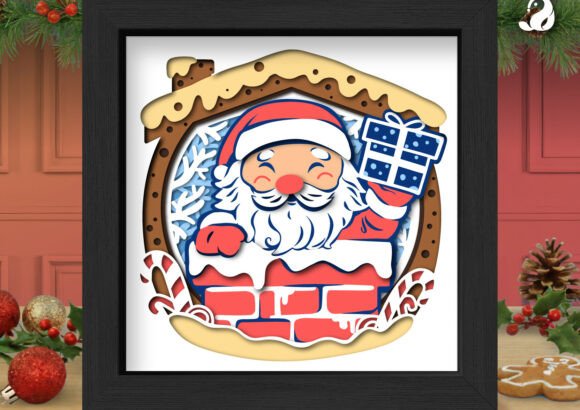
Creating a lasting impression during the holiday season often involves moving beyond flat decorations to embrace depth and dimension. The Santa's Christmas Night 3D Shadowbox represents a specific niche within paper crafting that combines silhouette art with layered construction to create an illusion of distance. This design features a classic silhouette of Santa Claus carrying his sack of toys, set against a massive, glowing full moon. The scene is completed with a snowy forest of pine trees and a night sky filled with stars, all framed within a beautiful circular border. For crafters evaluating their options for seasonal decor or handmade gifts, understanding the mechanics, aesthetic impact, and practical limitations of this specific design is essential before committing materials and time.
Understanding the Mechanics of Layered Silhouette Art
The primary distinction of the Santa's Christmas Night 3D Shadowbox lies in its reliance on multi-layered SVG files. Unlike standard die-cut projects where layers are stacked directly on top of one another, a shadowbox requires precise spacing between each cutout to create a parallax effect. When viewed from the front, the gaps between the layers allow light and shadow to play across the scene, simulating the vastness of a winter night. The high-contrast design is particularly effective because it relies on negative space; the viewer's eye fills in the details of the dark silhouettes against the bright background.
This approach differs significantly from traditional card making or simple window clings. In those formats, the focus is often on color saturation and surface detail. In contrast, the Santa's Christmas Night 3D Shadowbox prioritizes form and lighting. The inclusion of file formats such as SVG, DXF, EPS, AI, PDF, JPG, and PNG ensures compatibility with a wide range of cutting machines, from Cricut and Silhouette to professional plotter systems. However, the complexity increases with the number of layers. A clean, professional layer structure is vital; if the layers are not organized correctly, assembly becomes frustrating, and the final dimensional effect can be compromised by misalignment.
Evaluating Material Choices and Lighting Dynamics
A critical factor in the success of this project is the selection of materials, specifically regarding how they interact with light. The design is exceptionally suited for back-lit applications. When used in a light box, the moon and stars create a warm, inviting glow that highlights Santa's journey through the woods. To achieve this, the choice of cardstock color is not merely aesthetic but functional. Using a deep navy blue cardstock for the front layers creates a stark contrast against the background, ensuring the silhouettes remain distinct even when illuminated from behind.
Conversely, the moon layer requires a different approach. A bright, warm yellow or creamy white is recommended to mimic the natural luminescence of the moon. For those aiming for a softer, more magical glow, adding a layer of vellum paper behind the moon can help diffuse LED lights. This technique prevents harsh hotspots and distributes the light evenly across the scene. Without this diffusion, the light source might appear too aggressive, breaking the illusion of a serene night sky. Crafters must weigh the cost of these additional materials against the visual payoff, as cheap, thin papers may warp under the heat of LEDs or fail to block light effectively, ruining the shadow effect.
Comparing Shadowboxes to Alternative Decor Styles
When deciding whether the Santa's Christmas Night 3D Shadowbox is the right fit, it is helpful to compare it with other popular holiday decoration styles. Traditional painted canvases or printed posters offer high detail and color variety but lack the tactile engagement and three-dimensional presence of a shadowbox. While a poster can depict a complex scene with hundreds of colors, it remains static and two-dimensional. The shadowbox, while limited to silhouettes, offers a dynamic interaction with ambient light that changes throughout the evening as room lighting shifts.
Another alternative is the use of resin or glass ornaments. These items provide durability and a glossy finish but often lack the narrative scale of a shadowbox. A small ornament captures a moment, whereas the Santa's Christmas Night 3D Shadowbox creates an environment. It transforms a mantel or shelf into a stage for the holiday story. However, this comes with tradeoffs. Resin ornaments are generally easier to maintain and store, requiring less assembly and taking up minimal space. A shadowbox, being larger and constructed from multiple fragile layers, requires careful handling and dedicated storage space to prevent warping or damage over time.
Furthermore, digital frames have become a common alternative for modern homes. They offer versatility, allowing users to cycle through various images without physical effort. Yet, they lack the handmade charm and the specific warmth of paper and light. The Santa's Christmas Night 3D Shadowbox appeals to those who value the "maker" aspect of the holidays—the tangible result of cutting, assembling, and curating a physical object. If the goal is low-maintenance decor, a digital solution or pre-made ornament may be superior. If the goal is a unique, conversation-starting centerpiece that reflects personal effort, the shadowbox is the stronger candidate.
Ideal Use Cases and Situational Fit
The versatility of this design makes it suitable for several specific scenarios, though it is not a universal solution. It is ideal for festive mantel or living room decor where there is a dedicated spot for a display case or light box. The circular border frames the scene neatly, making it adaptable to various interior styles, from rustic farmhouse to modern minimalist, provided the frame matches the aesthetic. Additionally, it serves as an excellent option for Christmas night lights in children's bedrooms. The gentle glow of the moon and stars can act as a comforting nightlight, less intrusive than a standard bulb but still providing enough illumination for a child to navigate safely.
For craft business owners, this design represents a potential seasonal best-seller. Handmade gifts for friends and family often carry more sentimental value than store-bought items, and the Santa's Christmas Night 3D Shadowbox offers a premium feel. However, scalability is a limitation. Because the assembly process is manual and time-consuming, producing large quantities for mass retail may not be efficient compared to printing bulk items. It is better suited for boutique shops, Etsy stores, or custom orders where the price point can reflect the labor involved.
There are situations where this project may not be the right choice. Homes with very young children or pets that frequently knock over objects might find the delicate nature of layered paper risky. Similarly, environments with direct sunlight exposure could cause the colors of the cardstock to fade or the paper to curl over time. In such cases, a more durable material like acrylic or a sealed resin version of the same design might be a prudent alternative. The decision ultimately hinges on balancing the desire for a cozy atmosphere with the practical realities of the home environment.
Decision Factors for the Modern Crafter
Before purchasing the files or gathering supplies, consider the technical requirements. Do you have access to a cutting machine capable of handling the intricate details of the pine trees and stars? The Santa's Christmas Night 3D Shadowbox requires precision; a dull blade or incorrect pressure settings can result in jagged edges that detract from the smooth silhouette look. Additionally, evaluate your workspace. Assembling a multi-layered shadowbox requires a flat, stable surface and patience. Rushing the gluing process can lead to crooked layers, which immediately destroys the 3D illusion.
Cost is another variable. While the digital files themselves are often affordable, the cumulative cost of high-quality cardstock, vellum, a sturdy frame, and LED lighting can add up. Compare this total investment against the longevity of the piece. If the shadowbox is built well, it can be stored and reused for years, offering a higher return on investment than disposable decorations. However, if the project is intended for a single event or a short-term display, the cost per use may be higher than simpler alternatives.
Ultimately, the Santa's Christmas Night 3D Shadowbox is a tool for creating atmosphere. It excels in capturing the magic of Christmas Eve through the interplay of light, shadow, and depth. It is not merely a decoration but a crafted experience. By weighing the benefits of its immersive design against the demands of assembly and material quality, crafters can determine if this project aligns with their skills, resources, and holiday goals. Whether used as a personal keepsake or a commercial product, its ability to evoke the quiet wonder of a snowy night remains its most compelling attribute.